
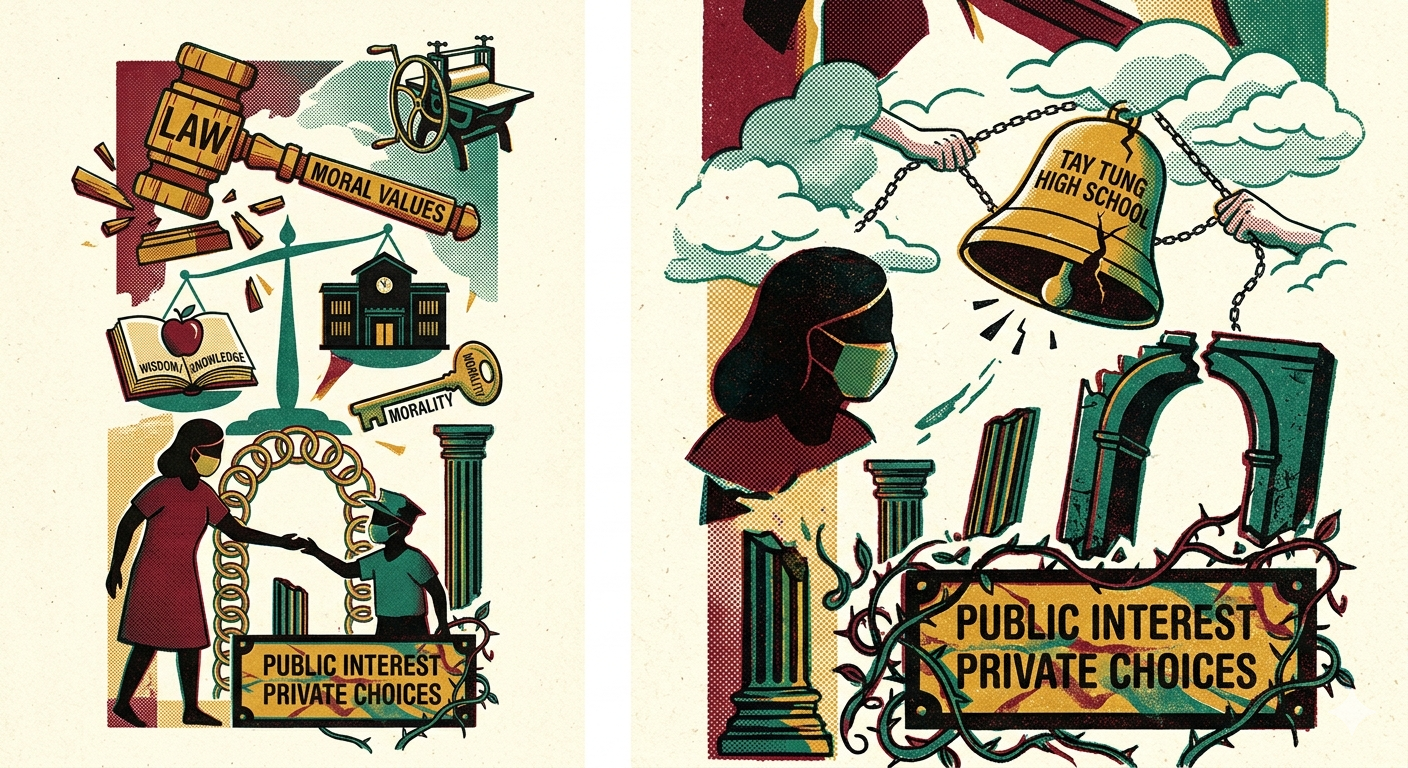
The Heart Has Reasons of Its Own Which Reason Does Not Know
There is a Philippine Supreme Court case from 1990 that reads almost like a love story — because, in many ways, it is one. But before it became a story of love vindicated, it was first a story of a woman fighting for her livelihood, her dignity, and her right to have fallen in love at all.
The Case at a Glance
Evelyn Chua-Qua v. Hon. Jacobo C. Clave and Tay Tung High School, Inc. G.R. No. 49549, August 30, 1990
Evelyn Chua-Qua was a classroom teacher at Tay Tung High School, Inc. She was dismissed by her employer on the ground of what the school called "abusive and unethical conduct unbecoming of a dignified school teacher" — conduct, they argued, that was "inimical to the best interest" of the institution and would "downgrade the high moral values of the school."
The charge, stripped to its essence: immorality. The reason: she had married her student.
A Love Story That Became a Legal Battle
His name was Bobby Qua. He was fourteen years her junior. When they wed on December 24, 1975 — Christmas Eve — Bobby was sixteen years old, and Evelyn was thirty. The school saw scandal. The law, eventually, saw something else entirely.
The case wound its way through the legal system, suffering reversals along the way — rulings that went for one party, then the other — before it finally landed before the Supreme Court. The central question was deceptively simple: Was Evelyn Chua-Qua lawfully dismissed on the ground of immorality?
What the Supreme Court Said
Justice Florenz D. Regalado, writing for the Court, delivered a ruling that has since become one of the more quietly poetic passages in Philippine jurisprudence:
"With the finding that there is no substantial evidence of the imputed immoral acts, it follows that the alleged violation of the Code of Ethics governing school teachers would have no basis. Private respondent utterly failed to show that petitioner took advantage of her position to court her student. If the two eventually fell in love, despite the disparity in their ages and academic levels, this only lends substance to the truism that the heart has reasons of its own which reason does not know. But, definitely, yielding to this gentle and universal emotion is not to be so casually equated with immorality. The deviation of the circumstances of their marriage from the usual societal pattern cannot be considered as a defiance of contemporary social mores."
The Court was equally firm on the labor dimension of the case. Tay Tung High School had waved its institutional values like a banner — but the Court saw through it:
"It would seem quite obvious that the avowed policy of the school in rearing and educating children is being unnecessarily bannered to justify the dismissal of petitioner. This policy, however, is not at odds with and should not be capitalized on to defeat the security of tenure granted by the Constitution to labor. In termination cases, the burden of proving just and valid cause for dismissing an employee rests on the employer and his failure to do so would result in a finding that the dismissal is unjustified."
In other words: you cannot hide an unlawful dismissal behind institutional piety.
The Final Verdict
The Supreme Court ruled in favor of Evelyn. Tay Tung High School was ordered to pay her:
Backwages equivalent to three (3) years, without deduction or qualification
Separation pay of one (1) month for every year of service
Why This Case Still Matters
Chua-Qua v. Clave endures not just as a labor case, but as a statement about the limits of institutional authority over the private lives of employees. An employer's moral standards, however sincerely held, cannot be weaponized to justify a dismissal that lacks evidentiary foundation. The burden of proof rests squarely on the employer — and here, the school failed to meet it.
And then there is Justice Regalado's now-famous line — borrowed from Pascal, shaped by circumstance — which reminds us that not every love that defies convention defies decency. Sometimes, the heart simply knows what it knows.
Evelyn and Bobby, it turns out, were proof of that.
This piece is part of The Final Verdict series by the Law Firm of Talampas & Associates, presenting landmark Philippine jurisprudence in accessible, narrative form.